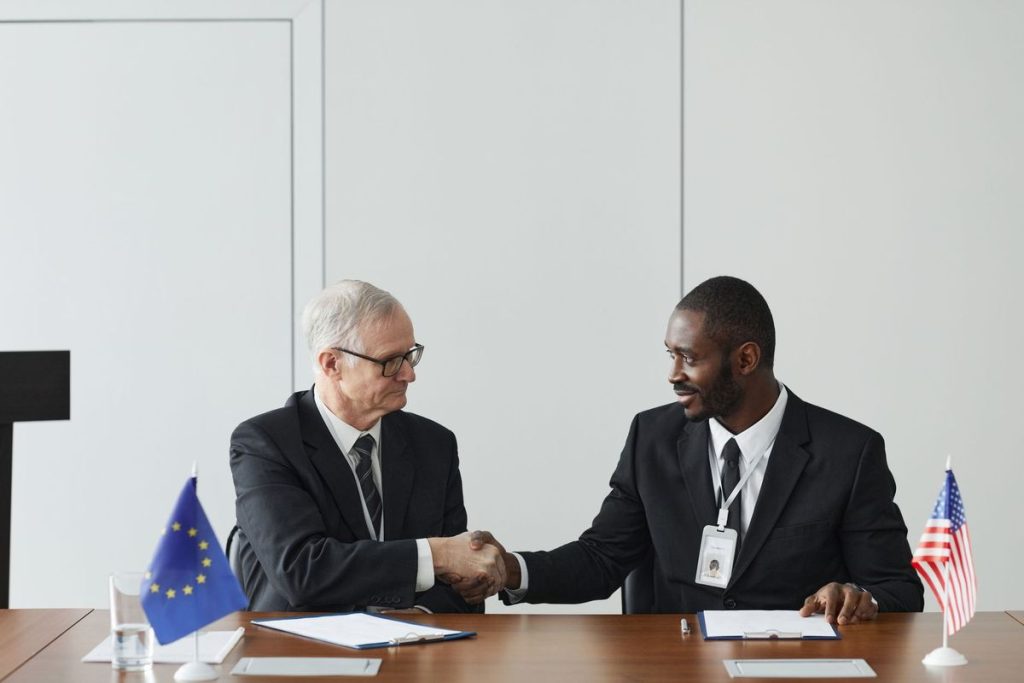
Recent developments in the relationship between the United States and Iran have seen a complex interplay of diplomacy and military posturing, prompting global attention. While US President Donald Trump announced that negotiations were set to resume with Iran, the Islamic Republic has stated it is indeed in talks, but specifically with Oman, not with the United States, according to the BBC.
This comes after President Trump reportedly called off strikes against Iran, simultaneously issuing a warning of a ‘last chance’ to sign a deal, as reported by CNN on 4th August 2026. These events underscore the delicate and often contradictory nature of international relations, particularly when involving key global players and volatile regions.
Background
The relationship between the US and Iran has long been characterised by periods of tension and complex diplomatic challenges. President Trump’s approach has often been described as direct, seeking to leverage pressure to secure specific outcomes. However, this strategy has reportedly met an ‘obstinate match’ in what The Guardian, in an article from 3rd August 2026, described as Iran’s ‘hardball regime’.
This context is crucial for understanding the current situation, where public statements and behind-the-scenes discussions often carry significant weight. The involvement of intermediaries, such as Oman, highlights the indirect pathways sometimes necessary for dialogue when direct communication is stalled or contentious.
Trump’s Stance and Warnings
President Trump’s recent actions and statements have painted a picture of firm resolve mixed with an openness to negotiation, albeit under specific conditions. CNN reported on 4th August 2026 that he had called off military strikes against Iran. This decision, however, was coupled with a stark warning that this represented Iran’s ‘last chance’ to sign a deal. The nature of such a deal, and its specific terms, remain subject to international scrutiny and diplomatic manoeuvring.
Despite the high tensions, President Trump also indicated a belief that negotiations with Iran would resume. This perspective contrasts with Iran’s immediate public response, highlighting a disconnect in the official narratives concerning direct engagement.
Iran’s Response and Diplomatic Channels
In response to President Trump’s assertions regarding renewed talks, Iran has offered a clarified position on its diplomatic engagements. According to the BBC, Iran has stated unequivocally that it is in talks with Oman but explicitly denied being in negotiations with the United States. This distinction is significant, as it suggests that while Iran is open to certain channels of communication, it is not currently pursuing direct dialogue with Washington.
Oman has historically played a role as a mediator in regional and international diplomacy, often facilitating discussions between parties that might otherwise struggle to communicate directly. Iran’s confirmation of talks with Oman, against the backdrop of denying US negotiations, underscores the complex and multi-layered diplomatic landscape at play.
FAQ
- Q: Is the United States currently in direct talks with Iran?
A: According to the BBC, Iran has stated it is not in talks with the United States, despite President Trump’s assertion that negotiations would resume. - Q: What actions did President Trump recently take regarding Iran?
A: CNN reported on 4th August 2026 that President Trump called off strikes against Iran and warned of a ‘last chance’ to sign a deal. - Q: With whom has Iran confirmed it is in talks?
A: Iran has confirmed it is in talks with Oman, as reported by the BBC. - Q: How has Iran’s approach to diplomacy been described?
A: The Guardian described Iran’s regime as ‘hardball’ and an ‘obstinate match’ for President Trump in an article on 3rd August 2026.
What this means for you
For readers in Oxford and Oxfordshire, as well as a general UK audience, developments in international diplomacy, particularly those involving major global powers and regions like the Middle East, have far-reaching implications. While direct impacts may not always be immediately apparent, the stability of international relations and the prevention of conflict are crucial for global economic stability, energy markets, and wider security. The complex dance between the US and Iran, characterised by both strong rhetoric and indirect diplomatic overtures, affects the delicate balance of world affairs.
Understanding these dynamics, even from a distance, provides valuable insight into the global political landscape that ultimately shapes aspects of national policy, economic conditions, and even the daily news agenda here in the UK. The pursuit of diplomatic resolutions, however challenging, remains a critical component of maintaining international peace and stability.